Wednesday, 21 March 2012

The Nightmare of Invasion

P1020438Hoi An, Central Vietnam – So amidst our adventure, we have a break! It seems a strange concept to consider something a holiday while travelling, but somehow it seems apt and the best way of describing four days at the beautiful Victoria Hoi An Beach Resort. Imagine a sun-kissed sea, with gentle rolling waves, a lone wooden fishing boat gently “phut-phutting” towards rich shoals of barren sea, the distant Cham Islands poking through the mist of the horizon, an infinity pool that lazily reflects the tall coconut palms, a gathering sunset with pinprick lights at sea where the local fisherman hunker down hopefully for a night’s toil in their bobbing boats, a room which opens onto a panoramic vista of breaking waves, where within 10 paces you can be rolling in the surf, an emerging sunrise with the sympathetic dragging sound of a water buffalo combing the beach with a hand-crafted wooden rake in tow, the nightly folklore stories left on our pillow alongside a single red rose… Disney right? Probably, but we were there… The stuff of dreams!

Hoi An is a gem, a former French colonial town of winding streets, beautifully balustraded upper floors, cascading Morning Glory flowers. At its centre, a vibrant and visually embracing local market, vendors who chase you down to get a sale and curiously ask “Why won’t you buy?” in an emotional onslaught against your wallet. Street vendors cooking on open charcoal stoves, creating wisps of enticing and appetizing smells. Traditional artisans making colourful silk lampshades, custom shoes, tailoring silk dresses. The magnificent 40km uninterrupted perfect white sand of of Cua Dai Beach effortlessly stretching between Hoi An and Danang. Wonderful… the resort allowed Nicky her guilty pleasure of BBQing herself to a gentle medium rare, while I relaxed into reading stories of a rich cultural past.

Vietnam has an incredible history of war, far more involved and complicated than I had any sense of. “The Eaves of Heaven: A Life in Three Wars” by Andrew Pham is a remarkably poetic description of one man’s life, his struggle to emerge through constant conflict, a lifetime of plenty followed by famine, and the cycle repeated. It’s compelling reading and beautifully written. He unravels a political landscape that is not only imposed externally by frequent invaders, but how internal struggles between factions supporting diverse ideologies ripped his country apart, where so often the enemy was within, where corruption and personal gain undermined the integrity needed to survive.

OK – Rant Alert! “Agitated from Surrey”: What is the POINT of amazingly BEAUTIFUL places when you have to share them with TOURISTS?? Time to name names… The Australian middle-aged-lady who loudly-and-aggressively criticised a young Vietnamese girl for not understanding her exact culinary requirements – why should anyone cook your omelette with one-hand tied behind their back while whistling “Waltzing Matilda”? The gentleman who abused a modest culture, not only wearing socks with his sandals, but tucking his long-sleeved shirt into the heaved-up waistband of his skimpy shorts, helpfully not buttoning his shirt to allow us all to see his undulating fat at rippling distance (where are the Fashion Police?) The French monsieur who dismissively mis-understood a waitress and berated her language skills – graciously she responded (with an almost English sense of understated wit) “I understand No Sir”. And what about the MUZAK? As Nicky so eloquently remarked, this “elevator music” is enough to make you take the stairs; I helpfully re-phrased this “…or an open lift shaft”. PLEASE please let Karen Carpenter rest-in-peace… [Breathe in, hold, count, one… two… three… relax. And again…]

Vietnam is embracing the tourist dream as a source of nationwide economic growth. Cua Dai Beach is being swallowed, whole – miles of beautiful coastline the subject of never-ending construction projects, one after the other. Back-to-back hotel resort monstrosities in process, where “Western Transplants” can bus in to a cheaper version of their “name badged” comfort zone, transferred, gated, and protected from incursion.

So the stuff of dreams… or a developing nightmare? I wonder. Since 1975, Vietnam has generally been at peace - so what of the next invasion? Of a tourist army determined to transplant a false ghetto of imposed culture? How can the traditional Vietnamese values and heritage be held preciously? It’s an unseen war playing out as we speak…

Sunday, 18 March 2012

Photo Journal: Seeking Brother Ho

IndoChina 2012 - 10 Seeking Brother Ho

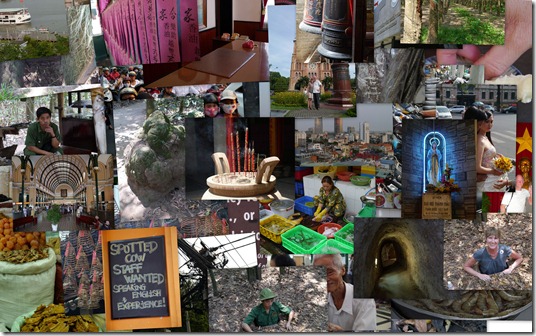
Saigon is a city with many stories to tell… we had 3 days exploring it, and came away feeling we’d only seen a glimpse.

Photo Journal: Seeking Brother Ho

Thursday, 15 March 2012

Re-learning the Green Cross Code

Ho Chi Minh City, Vietnam – Vietnam is part of the South-East Asian economic “miracle”. Arising from the 1990 decision to pursue a market economy within a communist regime, yearly GDP growth since that point has been 6-8%, the only red flag (apart from the national one) being an eye watering Inflation Rate of 16.4% in Feb 2012.

Ho Chi Minh City feels different – more people, more activity, more frenetic, more building works, more skyscrapers… The Bitexco Financial Tower was “topped out” barely a year ago, 72 floors, the tallest building in the city, with a striking resemblance to the Sail of the Burg in Dubai, also sporting its own helipad platform – tennis anyone? Saigon as was, still is to many, and is officially the name of Ho Chi Minh City’s “District 1”, which encompasses the financial district and its “resplendent” opulence of Gucci, Chanel, Louis Vuitton, Burberry… it’s a neon city with helpful western muzak everywhere; it reminds me of the change when Moscow and East Berlin were “transformed”.

“History is written by the Victors”

Vietnam is one of those places where a contemporary history plays out in our own lifetime - The “American War” (as it is known here). This poignant quote of unclear origin (but often associated with George Orwell or Winston Churchill) has added immediacy. The “War Remnants Museum” (presented by the Ho Chi Minh City Department of “Culture, Sports & Tourism”) is the first real demonstration of “communist propaganda” we’ve experienced in IndoChina - first exhibit “Historical Truth”. However it is also a fascinating, deeply moving and very troubling exhibition. My primary emotion circled around the horror and pointless nature of war; there are never truly any winners, the consequences always dominate, and the common man suffers. In truth I’d missed the French intervention post-WW2 to re-establish “IndoChine”, which lead to the 1954 Geneva Accord that separated North & South Vietnam along the 17th parallel. The exhibition “missed” any reference to an invasion of the South in 1965 or the consequent “Boat People” tragedy in 1975, preferring to talk in terms of a liberating army from the “South Vietnam Puppet Government” – fascinating to see those exact words on numerous wall charts. Somewhat perversely, Vietnam is now courting Western & particularly American favour – Clinton lifted economic sanctions in 1994, cemented by a 2000 visit. Vietnam (as are all in IndoChina) is wary of China, referred to as “Big” Brother… a series of autocratic moves, particularly in damming the Mekong, has created unease… bigger brothers can often be bullies too.

So what of Saigon today? It thrives with street vendors, a bustling Chinatown, markets… a popular tourist sport is to walk the tightly packed market aisles, 2+ feet wide, where local vendors assault you, trying to put shirts on your back! I’ve renewed my long-lost love affair with “rocket fuel”, Vietnamese coffee – strong black iced coffee, with condensed milk to flavour. The flower stalls everywhere… it’s a beautiful and bustling city – did I mention the traffic?

Those of us “of an age” may remember Tufty or a jolly Green Giant, a superhero proclaiming road safety for UK citizens: The Green Cross Code – Stop, Look, Listen, Think! In Saigon, “Think” turns into raw “Panic”. At each junction you are faced by a seething mass of carnivorous scooters – there’s no let-up, they are always there, mystically appearing before your eyes with bared fangs. We were advised by locals on how to cross the road and I’m afraid Tufty will be turning in his squirrel grave: Step out SLOWLY into the traffic, keep moving slowly and evenly forward. Do NOT speed up, and NEVER turn back. Occasionally pause if deemed “necessary”… strangely, it works. As you enter the abyss, the scooter sea parts giving you a small channel like the bow of a breaking wave in which to continue. The “slowly” allows the scooter cavalry to sense where the gap around you may be and gently alter course to pass in front or behind you (all at top speed of course). It’s a heart-in-the mouth experience… but the alternative of waiting for a Green Superhero is clearly a cartoon fable!
Saigon retains a lot of its fabled allure and romance. It’s a city re-discovering itself, creating a new history, while living within its own past. I met and spoke with Mr Duong Van Ngo, a wonderful stately gentlemen of 80 who sits each day in his designated seat at the Saigon Post Office, helping local people to read, or simply go about their business in the post office. He has worked in this supremely grand building (it reminds me of Grand Central Station in NYC) for 60 years, the last two decades as a volunteer post-retirement. His english is cultured and he emanates a calm and sincere grace that inspired me. Duong will have met & helped many people over the years – I would love to spend hours listening; I wonder what stories he has to tell?

Wednesday, 14 March 2012

Photo Journal: The Enchanting Mekong Delta

The Enchanting Mekong Delta

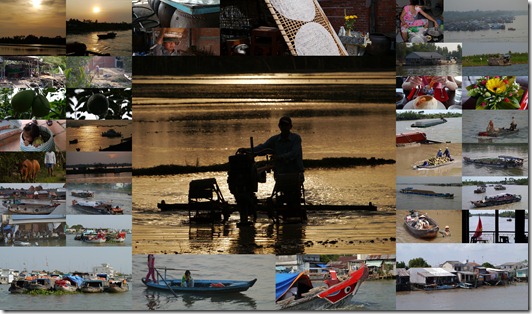
We began our journey through Vietnam by spending two glorious days exploring the Mekong Delta on the Bassac Boat. The fertile arable lands of the Mekong are incredibly beautiful and enchanting… for the village locals a simple life, based around the rivers and waterways, but one with so much richness!

Photo Journal: The Enchanting Mekong Delta…

Sunday, 11 March 2012

Time for a Restaurant Review…

Phnom Penh, Cambodia – While we’ve been travelling, we’ve happened several times upon an interesting NGO (Non-Governmental Organisation, read Charity) that works with street children. Friends International, started in 1984 in Cambodia, is based across IndoChina and does fantastic work. Their website states:

sub-bannerpic3

Friends-International works with marginalised urban children and youth, their families and communities to become productive, independent citizens of their country. We do this by listening to and being guided by those who matter the most to us - the children and youth we work with everyday.

Exploring a little how they do this made me sense that they have developed a really good and “best practice” model that seems to be making a significant difference. Their charter would make interesting reading and a good template for many charities!

So the challenge for any NGO is that you can innovate and develop numerous ways of doing a better and more expansive job of your core mission, but it needs to be funded. So the traditional nightmare… help please Mr Westerner?

So, time for a restaurant review?

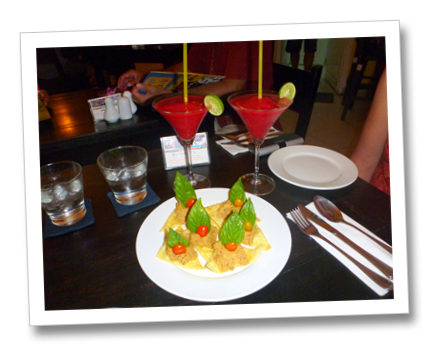
Last night we ate at Friends. It’s a highly rated restaurant and we enjoyed it immensely. It’s different in that it is a tapas bar, serving small portions of various Khmer, Asian, & Fusion dishes. Set in a former French Colonial building, the food is extremely tasty, beautifully presented, with lots of interesting flavours mixed together in creative and delicate ways. The atmosphere reflects the wonderfully energetic streets & city, full of colour & intrigue. Our meal was not expensive ($26 for both of us, inc drinks); we particularly liked the Grilled Fish with Salsa Verde & Chickpea Hummus on crisply fried flour tortillas. Service was superb, efficient, and the whole evening was a delight. Rating: 11/10.

So was that last paragraph a commercial break? In a weird twist of words – maybe! Friends the Restaurant is owned by Friends International. Quite the business model; they own four restaurants – we’ve eaten at two of them (Friends & Makphet).

But it doesn’t stop there… this is truly a “social enterprise”. Each restaurant is staffed by former street children, as part of their higher level training and re-integration back into society. Operating as Students & Teachers, both serving and cooking, they are learning and perfecting a trade that has economic currency; many graduate to be able to work in the hotels and restaurants of the city.

So is it working – try getting in without a reservation! In Phnom Penh, Friends is #1 of 278 on TripAdvisor, Romdeng #2. In Vientiane (Laos), Makphet is #1 of 119. The food is very good, but its more than that… the ethos, the atmosphere, the sense of being part of something far larger and with more purpose than eating a mere tapa… that has currency; they are doing a superb job with an innovative “integrative business model”.

Friends International – a different kind of NGO… did I mention their Frozen Raspberry & Lime Daiquiris are to die for?

Saturday, 10 March 2012

The Jewel of IndoChina

Foreign Correspondents Club, Phnom Penh, Cambodia – This city, often dubbed the “jewel”, seems a bit of an enigma on first look. It’s clearly complex and hides many stories; it had a rich history with strong French influence, was wiped out, and is now trying to re-create and rebuild a culture that was “de-programmed”. I find I have not immediately warmed to it in two days here, but sense that it’s a place that could grow into you and that its tendrils could easily enchant given time.

Choeung Ek - The StupaIt’s impossible to be here without exploring the contemporary history. Phnom Penh fell to the Khmer Rouge on April 17th 1975, weeks before the fall of Saigon. It heralded in a Communist “revolution” the likes of which no-one anticipated or foresaw, but which Pol Pot had clearly planned over the previous decade. Phnom Penh, a city of 2m+ people was evacuated, the population moved to the remote countryside to create a new “utopia” based on a agrarian economic ideal. Pol Pot was in power for only four years, 1975-79, before Cambodia was liberated by the Vietnamese, then ruled by them for a further decade. It wasn’t until 1993, when the monarchy was re-established and free elections were held under the sponsorship of the UN (which perversely elected communists), that Cambodia started to re-embark on peace, but even then Pol Pot was at large, living in the hills to the north with a small army and cadre of weapons to protect him. That he never came to justice is likely an indictment that we all bear. He died in 1998, likely from Malaria, and finally a country and its people were able to start to move on.

The recent history of IndoChina is one that all of us of an age likely remember snippets of. I remember well moving to California a mere decade after Vietnam; it was a few months before I put my finger on the gap, the realisation that many of the people I was spending time with had been involved in the Vietnam conflict, yet were unable to acknowledge or talk about it. America had “failed” in their eyes, and a relatively young and supremely successful society was trying to come to terms with that, initially with denial. Being here in Cambodia, shows a far more raw expression of that. The “Killing Fields” saw a massive “re-education” program which removed all opposition… intellectuals, teachers, doctors, officials; 3m Cambodians died in under 4 years, leaving a population of 4m, now 14m some 30 years later. So it’s a young “country” rediscovering its culture and heritage. Yet look around and chat to people (everyone seems remarkably open), they all have a story; everyone was affected.

S-21: Tuol Sleng Genocide MuseumWhen travelling, one of my indulgences is to read a book about the country I am in. I have been reading “River of Time” by Jon Swain, which is beautifully written and “part love letter to the land he so adores”. He was a journalist during the Vietnam conflict and was one of four depicted in the film “The Killing Fields” during the fall of Phnom Penh. He provides real insights, but has helped to add colour and an additional dimension to our experience here; it seems to underline that the Hollywood depiction we all saw is likely slightly glossy, but my surprise is, in truth, it seems a remarkably accurate depiction. We all saw the young testosterone filled child soldiers in their black pyjamas, flip flops, red & white checked headbands, & the obligatory AK47. I’d assumed this was a cinematic trick, but I was wrong. And you realise that the boy soldiers of the Khmer Rouge would now be entering their 50’s; who and where are they, and what legacy do they bring… is it a constructive one, or do the scars and indoctrination of those years still blind?

P1010829

We visited the “Killing Fields” memorial at Choeung Ek. It is a deeply humbling & poignant place. A central Stupa (“burial ground”) provides a fitting memorial, rising 17 levels, each filled with skulls, exhumed from the nearby mass graves, & their clothes… all visible behind acrylic glass. A quiet and profound silence as people wandered around dazed, often in tears. I visited Belsen in Germany as a teenager, but somehow this was more… likely because of the detail (the Khmer Rouge were vociferous record keepers) and the starkly assaulting visual pictures. Visiting S-21 (Tuol Sleng Genocide Museum) in Phnom Penh, the prison & torture centre, provided even starker reminders. Row upon row of black and white photos, each of a victim. Graphic pictures of life inside… It’s all a bit too much to take in, and we scarcely needed a guide to helpfully point out the details of the atrocities; it was there, tangible.

I’m struck by the enormity of Man’s cruelty to Man – I’m overwhelmed by it & can’t comprehend it, but in this place I can touch and smell it.